Opt out of AI training in robots.txt: one signal for four AI companies
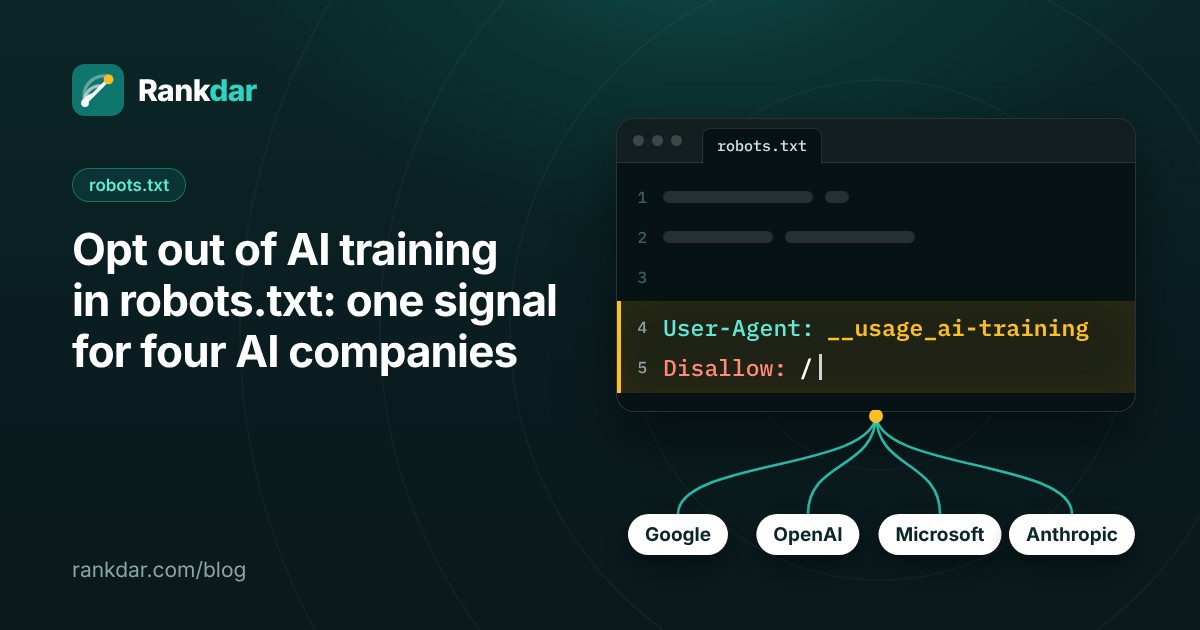
One robots.txt group, __usage_ai-training, tells four AI companies you don't want their models trained on your content: how to write it, when each starts reading it, and what it means for search and Gemini.
In this article
- Where the signal comes from
- How to write it in robots.txt
- When each company starts
- Refusing training keeps you in search
- Write the file for what you want
- Refuse training, and the Gemini apps don't matter to you
- Refuse training, but stay in Gemini app answers
- Your file already names crawlers
- What the signal does not do
- See what your file says today
On 30 October 2026, Google, OpenAI, Microsoft and Anthropic each said they will honor a single robots.txt signal that tells them a site does not want its content used to train AI models. The signal is called __usage_ai-training. You write it once, instead of naming every company's crawler.
Below: how to write it, when each company starts reading it, and what it changes for your site in search and in AI answers.
Where the signal comes from
It is defined in an Internet-Draft at the IETF, written by Kevin Kelley of Anthropic. The first version came out on 30 October and the second on 16 November 2026. It is an individual draft, not an IETF standard, so the details may still change.
Until now you had to know each company's crawler: GPTBot for OpenAI, ClaudeBot for Anthropic, Google-Extended for Google. Those names keep working alongside the new signal.
How to write it in robots.txt
It is an ordinary robots.txt group, with the signal's name on the User-Agent line where a crawler's name would go:
User-Agent: __usage_ai-training
Disallow: /
Disallow on a path means you would rather its content were not used for training; Allow means you are fine with it. Paths follow the usual robots.txt rule, where the more specific path wins. The draft's own example refuses training across the site except the press-kit folder:
User-Agent: __usage_ai-training
Disallow: /
Allow: /press-kit/
Three things to know:
No group, no preference. A file without an
__usage_ai-traininggroup says neither yes nor no.User-Agent: *does not cover it. A catch-all rule that blocks every bot is not an AI training refusal under this signal.It does not stop crawling. It states how you want your content used, not whether bots may fetch it. To keep a bot out, name that bot.
When each company starts
What each company announced on 30 October 2026:
Company | What it said | When |
|---|---|---|
If a site refuses training with the signal and does not name Google-Extended, Google will treat it as a Google-Extended disallow (Search Central blog). | In 2027; Google's crawler documentation says early 2027. | |
Microsoft | Bing reads the signal, adds a per-page training preference by meta tag or HTTP header, and a separate per-page preference for whether AI answers in Bing and Copilot may be grounded on the page. | From 1 February 2027, as Bing recrawls each page. |
OpenAI | Will honor the signal for foundational generative AI training; GPTBot rules stay as they are. | No date given. |
Anthropic | Has started honoring the signal, and treats a rule that names ClaudeBot as more specific than the general signal. | From 30 October 2026, rolling out across its services. |
If your site relies on NoArchive or NoCache for Bing, note that Microsoft will stop reading them as training or grounding preferences after 1 March 2027.
Refusing training keeps you in search
Google says Google-Extended does not affect a site's inclusion or ranking in Google Search, and Microsoft says its new training preferences leave a site eligible for Bing results.
The Gemini apps are the exception. Google says a site that refuses training with the shared signal but allows Google-Extended by name stays eligible to appear in Gemini app responses and to get clicks from them. Refuse training with the signal without naming Google-Extended, and once Google starts reading the signal, the Gemini apps will no longer use your content in their answers.
AI Overviews and AI Mode are not part of this. They are Google Search features, governed by your Googlebot rules rather than Google-Extended, and they have their own setting in Search Console, Search generative AI, which Google opened to every site on 31 August 2026 and which, it says, does not affect training.
Write the file for what you want
Refuse training, and the Gemini apps don't matter to you
User-Agent: __usage_ai-training
Disallow: /
Leave your other crawler groups as they are.
Refuse training, but stay in Gemini app answers
User-Agent: __usage_ai-training
Disallow: /

User-Agent: Google-Extended
Allow: /
Allowing Google-Extended also lets Google train Gemini models on your content. With Google, training and appearing in the Gemini apps come together; you cannot have one without the other.
Your file already names crawlers
If your robots.txt has rules for GPTBot, ClaudeBot or Google-Extended, check that they agree with the new signal. A company follows the rule that names its own crawler: refuse training with the signal but allow ClaudeBot, and Anthropic will follow the ClaudeBot rule. Since not every company reads the signal yet, keep those rules until the ones you care about do.
What the signal does not do
It is a preference the four companies have said they will honor. It does not technically block any bot.
It binds only the companies that say they will follow it.
It may change: it is a draft, and Anthropic says the way it reads and applies these settings may change too.
See what your file says today
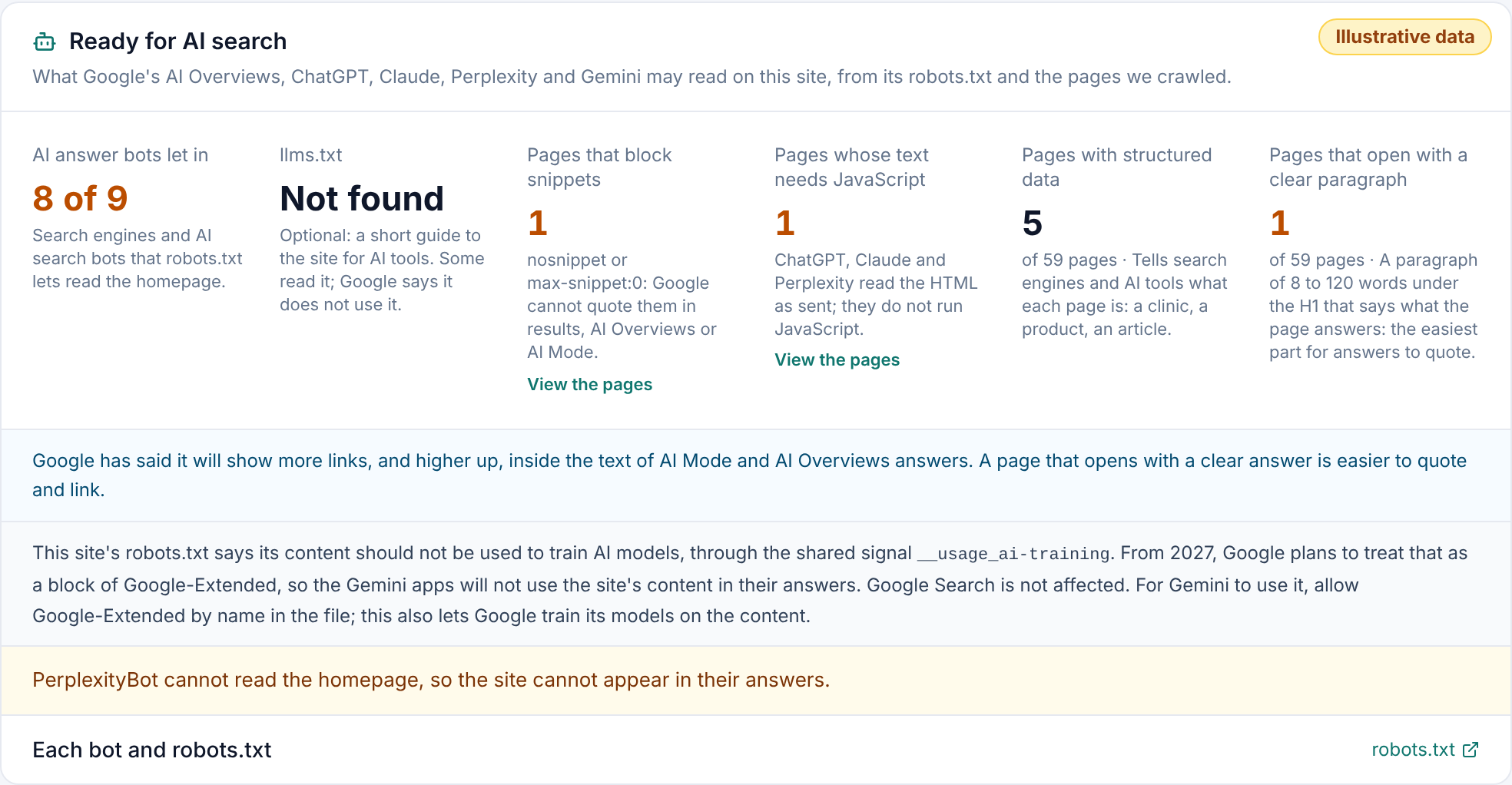
Rankdar's Site Health audit now reads the signal in its Ready for AI search section. If your robots.txt refuses training with it, the audit adds a note on what that means for your site in Gemini, next to the table of bots your file lets read the home page. Rankdar also reads your sites' robots.txt once a day and tells you when it changes, including when it starts or stops refusing training with this signal.
For a quick look at which AI bots your site lets in, and whether your file refuses training with this signal, run the free check. For every company's crawlers and what each one does, read GEO from the source.
- #robots.txt
- #AI training
- #AI search