Medical Search Volume in Google Keyword Planner: How to Read It Before You Plan
Google Keyword Planner figures for nine medical keywords in Egypt: what the monthly average means, why close spellings share one number, and how to check them in Search Console.
In this article
Before you write a clinic page or plan an ad campaign, you need to know how often people search for the specialty you offer. Those numbers come from Google itself, through Google Keyword Planner. This article gives its figures for nine medical keywords in Egypt, searched in Arabic, and explains how to read them before you build a plan on them.
Google Keyword Planner figures for nine medical keywords in Egypt
We read these figures in Google Keyword Planner on 12 and 13 November 2026, for Egypt and the Arabic language. Each one is the average monthly searches from November 2025 to October 2026.
Keyword | In English | Average monthly searches |
|---|---|---|
دكتور مخ واعصاب | neurologist | 14,800 |
دكتور انف واذن وحنجرة | ENT doctor | 9,900 |
دكتور الجلد | dermatologist | 9,900 |
دكتور عيون | eye doctor | 8,100 |
دكتور اطفال | pediatrician | 6,600 |
افضل دكتور عيون في مصر | best eye doctor in Egypt | 590 |
افضل دكتور عيون في المنصورة | best eye doctor in Mansoura | 590 |
افضل دكتور عيون في المهندسين | best eye doctor in Mohandessin | 260 |
افضل دكتور عيون في الدقي | best eye doctor in Dokki | 210 |
The number is a yearly average, not a month
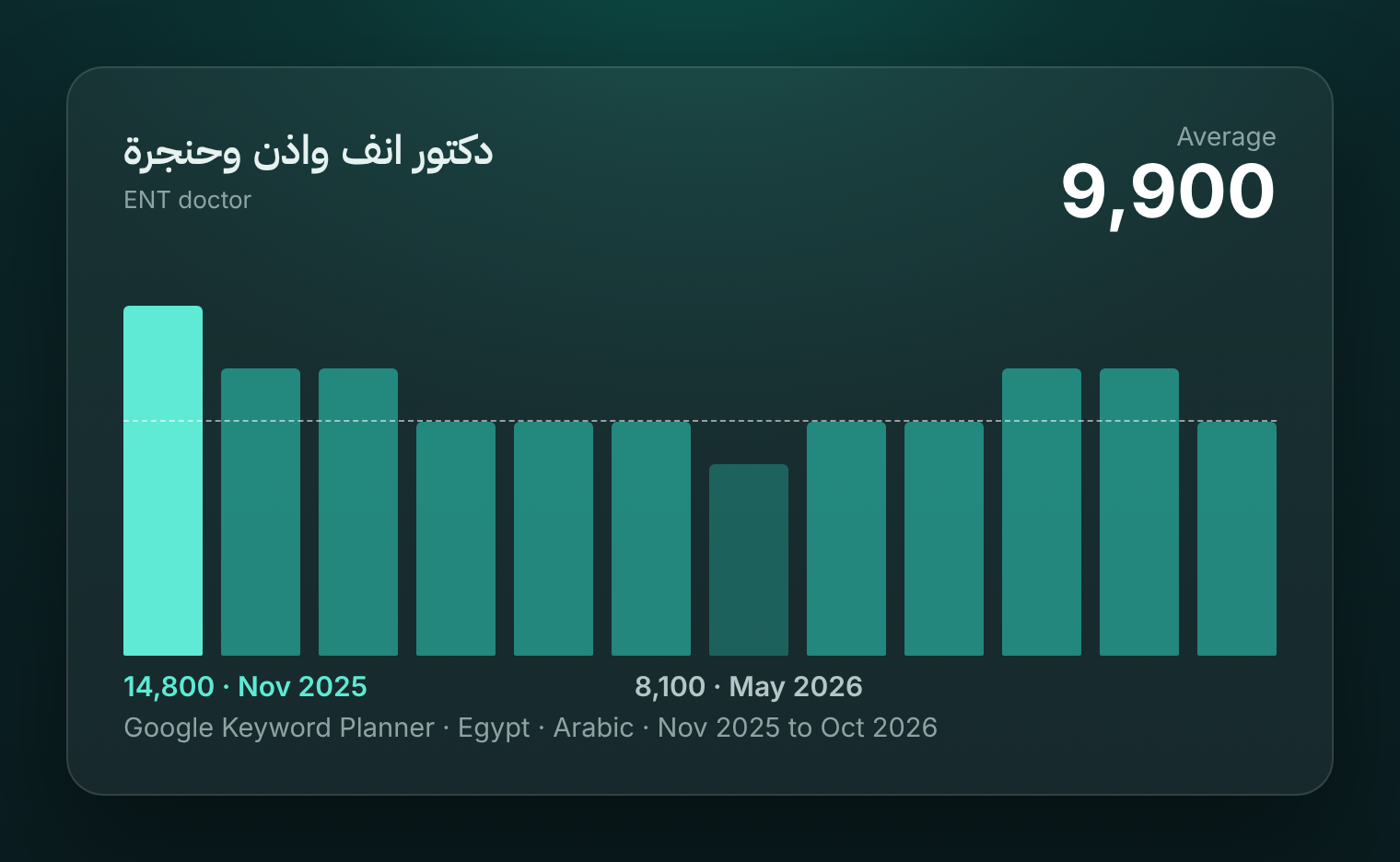
The figure the tool shows is the average monthly searches over twelve months, as Google's help page says, rounded to steps Google uses, such as 6,600, 8,100, 9,900, 12,100 and 14,800. Searches in any given month go up and down. The ENT doctor keyword averages 9,900, but its monthly searches ranged from 8,100 in May 2026 to 14,800 in November 2025. So do not base one month's budget on the average: open the keyword's monthly chart before you decide.
Close spellings share one number
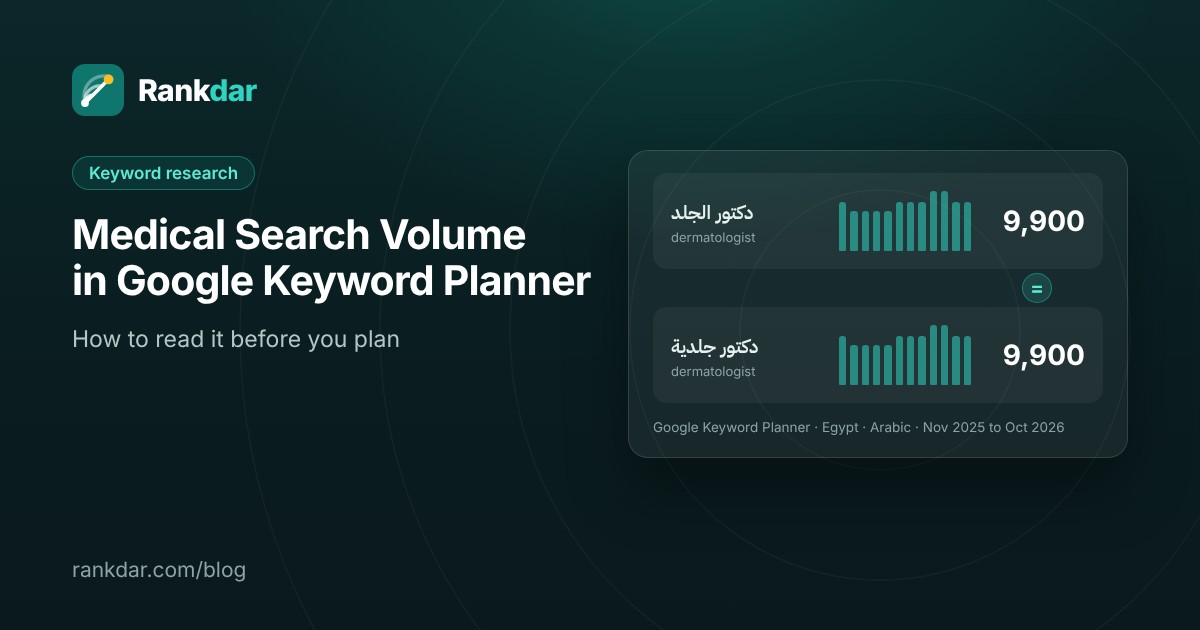
We entered three ways of writing dermatologist in Arabic, دكتور الجلد, دكتور جلدية and دكتور جلديه, and Google gave all three the same figure: 9,900. The first two matched in every one of the twelve months. Google groups close spellings under one number, so they do not add up to 29,700. Pick the spelling closest to what your patients type for the title, and use the others in the text where they read naturally. The Arabic keyword research guide covers spelling variants in more depth.
Local searches are small but they matter
District keywords have much smaller numbers: 210 for best eye doctor in Dokki and 590 for best eye doctor in Mansoura. But someone who types their district is usually looking for a clinic to visit soon, so these keywords sit closer to a booking than the general ones. Small numbers also move more from month to month: the Dokki keyword ranged from 110 to 260 searches a month over the same year. For the steps to show up on Google Maps and in local results, read the local SEO guide for clinics and doctors.
When a tool shows no number
A tool may show no number for a medical keyword, or an old one. Open it in Google Keyword Planner itself, but know that Google sometimes shows no number for a keyword either: on 14 November 2026, Keyword Planner showed a dash instead of a number for دكتور مسالك بولية (urologist) in Egypt. And a number can come back: when we asked Google about دكتور جلدية (dermatologist) on 17 October 2026, it had no number; on 14 November it was 9,900. So a dash does not mean nobody searches for the keyword. Open it again in a month, and look at your site's impressions for it in Search Console if your site appears for it. And check the date of any figure a tool shows you, because a number from a year ago can be far from today's.
Check it against Search Console impressions
Keyword Planner estimates searches; Search Console shows how many times your site actually appeared in Google's results for each keyword. When your site is on the first page for a keyword, its impressions come close to the number of searches for it, and they are a floor for that number. Compare the two every few months, and record every figure with its date and source.
The bottom line
Read the figure as a rounded yearly average, open the monthly chart before you plan a particular month, do not add up the numbers of close spellings, look at the date of any figure a tool shows you, and check against your impressions in Search Console. And do not drop a medical keyword from your plan because a tool shows no number for it today, even if that tool is Keyword Planner itself.
- #Keyword research
- #Medical SEO
- #Keyword Planner