Arabic Search in Egypt and Saudi Arabia: Five Figures from Rankdar's Study
Five figures from Rankdar's study of 1,000 Arabic searches in Egypt and Saudi Arabia: how often Google's AI Overview appears, which sites it and ChatGPT cite, and what fills the first page on mobile.
In this article
- 1. Google's AI Overview shows on most searches
- 2. In Egypt, Facebook is the site the Overview cites most
- 3. YouTube and social networks on mobile
- 4. ChatGPT names a source in about three answers out of four
- 5. Under half of what ChatGPT cites is on Google's first page
- Also in the study
- How we ran the study
- What to do with these figures
At Rankdar we read Google's results for 1,000 popular Arabic searches in Egypt and Saudi Arabia, across nine fields from health and real estate to travel and shopping, on desktop and for most of them on mobile too, and put 1,000 questions to ChatGPT in the same fields. All the figures, with the study's method and limits, are in the Arabic search study. These are the five that matter most.
1. Google's AI Overview shows on most searches
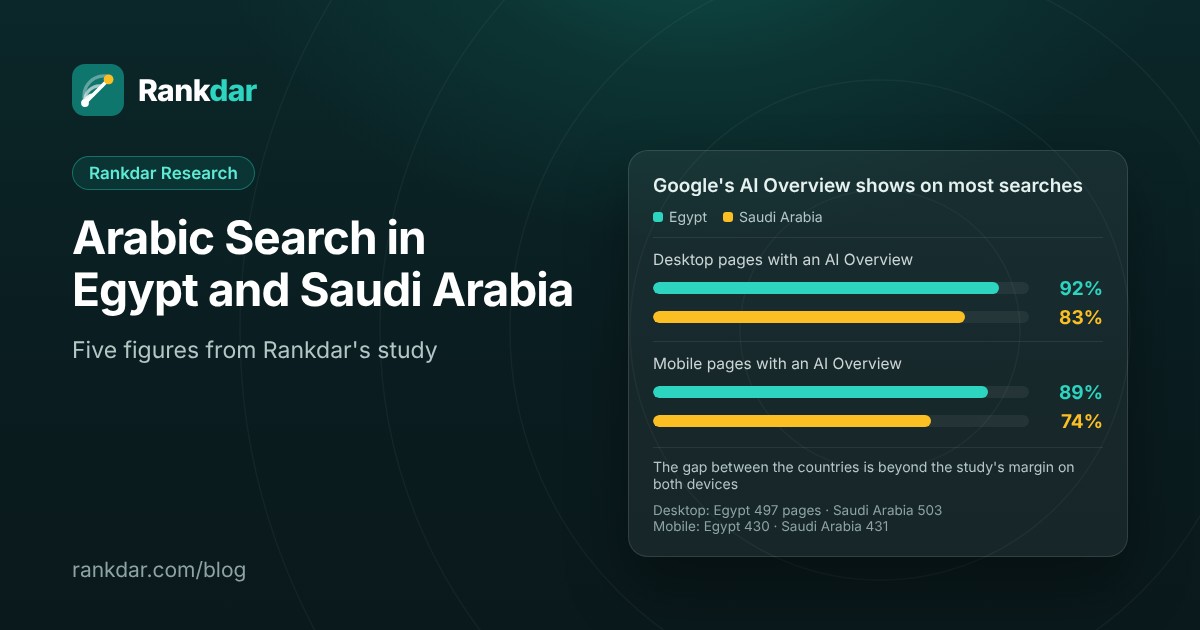
On desktop, the AI Overview appeared on 92% of the pages we read in Egypt (456 of 497) and 83% in Saudi Arabia (419 of 503); on mobile, on 89% (381 of 430) and 74% (317 of 431). It shows more in Egypt on both devices, by more than the margin of error. It shows less in travel, food and services (65% to 72%) than in the other six fields (88% or more). These are popular searches, so the shares don't stand for all of Google search. Google brought AI Overviews to the Middle East and North Africa, and to Arabic, on 20 May 2025.
2. In Egypt, Facebook is the site the Overview cites most
On desktop, the Overview cited a social network on 38% of the pages where it appeared in Egypt (173 of 450) and 21% in Saudi Arabia (86 of 419). In Egypt, Facebook leads every site: it was among the sources on 35% of those pages (156 of 450), 12 points ahead of Dubizzle in second place (22%). In Saudi Arabia the leading sites are close together: Haraj 13% (55 of 419), Instagram 9% (39) and Aqar 9% (37). These shares are lower bounds, since we couldn't match every source name to its site.
3. YouTube and social networks on mobile
On mobile, YouTube was among the first-page results on 35% of pages in Egypt (139 of 393) and 21% in Saudi Arabia (84 of 398), and at least one social network was there on 34% (135 of 393) and 21% (83 of 398). In Egypt three sites run close: YouTube 35%, Dubizzle 31% and Facebook 30%, so none of them leads. YouTube is strongest in food, at 72% (average of the two countries). If your field depends on explaining or showing, video may be another way onto the first page.
4. ChatGPT names a source in about three answers out of four
ChatGPT cited at least one source in 77% of its answers in Egypt (384 of 497) and 76% in Saudi Arabia (383 of 503), with wide swings by field, from 97% in real estate to 31% in health (average of the two countries, over 800 answers). In Egypt Dubizzle leads, appearing in 17% of answers with a source (64 of 384), 10 points ahead of the next site. In Saudi Arabia Aqar comes first at 9% (36 of 383), with gaps to the sites after it within the margin.
5. Under half of what ChatGPT cites is on Google's first page
We checked every site ChatGPT cited against Google's first page for the same search. Only 37% of its citations in Egypt (320 of 867) and 36% in Saudi Arabia (298 of 837) went to sites on that page, and no way of matching we tried brought the share to half. It ranges from 2% and 6% in food to 60% and 64% in real estate. From Google's side, only 12% of the sites on the first page in Egypt (320 of 2,672) and 10% in Saudi Arabia (298 of 2,990) appeared in ChatGPT's answer to the same search.
Also in the study
The full study shows the AI Overview field by field, the sites that fill the first page on desktop, the share of local domains (.eg and .sa) in Google's results and in ChatGPT's citations, and parts of the results page such as People also ask, videos and the map. The Overview cited Reddit or Quora on just two pages in each country. The study also measures how the first page changes from day to day: the top site changed in 15% of comparisons between two consecutive mornings in Egypt (182 of 1,226) and 16% in Saudi Arabia (181 of 1,116).
How we ran the study
The study rests on 1,000 popular Arabic searches, 497 in Egypt and 503 in Saudi Arabia, whose Google pages we read on desktop, plus 861 mobile pages and 1,000 ChatGPT answers. We read them between 9 and 16 November 2026 from an IP address in Cairo, and set the Saudi pages to Saudi Arabia with Google's country setting. The day-to-day measure comes from Search Radar's daily reads of 108 searches per country, from 26 October to 9 November 2026. No customer's keywords or data are part of the study. On the study's page, every figure shows the counts behind it, along with the margins of error and the study's limits.
What to do with these figures
Check whether the AI Overview shows for your own keywords: Rankdar shows it for every keyword you track.
In Egypt your Facebook page may be one of the Overview's sources, so give it the care you give your website.
If YouTube shows up often on your field's first page on mobile, make video part of your plan.
Ranking on Google isn't enough on its own to show up in ChatGPT, so track both.
The full study is in Arabic and English on Rankdar Research. We publish a new edition every three months to see how these figures change.
- #Rankdar Research
- #AI Overviews
- #Arabic SEO